Key Takeaways
- →Emergent, founded by Dunzo's Mukund Jha, went from a $23M Series A to a $1.5B valuation in roughly 12 months — one of the fastest paths to unicorn status in recent Indian startup history.
- →The Series B-to-C valuation jump (from $300M to $1.5B) was backed by ARR doubling in the same window ($50M to $100M) — a jump with a real metric behind it, not a purely narrative one.
- →Jha's very public Dunzo shutdown functioned as a credibility signal rather than a liability, because investors could underwrite a founder who had visibly absorbed the lessons of a public failure.
A founder whose last company, Dunzo, collapsed publicly is not the obvious pitch for a $1.5 billion valuation. Mukund Jha built that pitch anyway, and investors funded it three times in the space of a year. This is a look at what the funding velocity behind Emergent's rise actually signals, what the metrics say about whether the valuation was earned, and what founders should take from a founder's second act moving this fast.
#The Founder
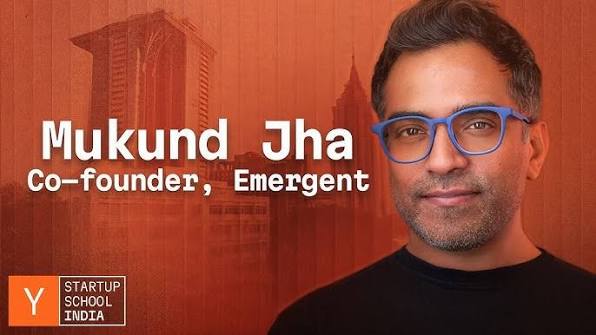
Emergent is an AI-powered "vibe coding" platform: type a plain-language prompt describing an app, and the platform handles the coding, deployment, hosting, testing, and debugging that would otherwise require a developer. It's headquartered in San Francisco, with the majority of its employees based in India. It was founded by Mukund Jha, who previously founded Dunzo, the once-prominent Indian quick commerce startup that ultimately collapsed.

Dunzo's shutdown is relevant here as a data point in Jha's trajectory, not as a punchline. It's the most public, most scrutinized thing about his track record, and it is exactly the kind of fact investors weigh heavily when deciding whether to back a repeat founder's next company.
#A Founder's Prior Failure as Signal, Not Liability
The instinctive read on a founder whose last company collapsed is that it should make the next raise harder. In practice, for a founder as visible as Jha, the opposite is often closer to true. A founder who has never been tested is an unknown quantity — investors are underwriting potential, with no evidence of how that person behaves when a company is actually failing: how they cut costs, how they're honest with a board, how they decide when to shut something down versus prop it up. A founder who has lived through a public shutdown has already generated that evidence, whether or not they wanted to.
Dunzo's decline played out publicly — delayed salaries, executive departures, and a wind-down covered extensively in Indian business media. That level of scrutiny means Jha could not paper over what happened even if he wanted to, which paradoxically makes his account of what he learned more credible, not less. Sophisticated investors, particularly in categories where execution speed matters more than a clean track record, often weight a founder who has visibly absorbed the lessons of a public failure more heavily than one who has simply never been tested. The pitch wasn't "trust this idea." It was "trust what I learned building the last one."
The pitch wasn't "trust this idea." It was "trust what I learned building the last one."
This only works if the founder can be specific about it. A vague "I learned a lot" answer in a pitch meeting reads as evasive. A concrete account — what broke, what Jha would do differently around burn, hiring, or product focus — reads as exactly the kind of pattern-recognition investors are paying for when they back a second-time founder over a first-time one.
#The Funding Sequence
Strip away the founder narrative and the funding data tells its own story. Emergent raised three institutional rounds in roughly a year, each one arriving faster than typical fundraising cycles would predict — a $23M Series A, followed four months later by a $70M Series B at a $300M valuation, followed six months after that by a $130M Series C at a $1.5B valuation.
Three Rounds, Twelve Months
Three rounds in roughly twelve months, with only four and six months between successive raises, is unusually fast even by the standards of the current AI funding cycle. That pace signals two things simultaneously: strong investor conviction in the underlying growth numbers, and real competitive urgency in the "vibe coding" category, where well-capitalized players are racing to lock in users and mindshare before the market consolidates around a handful of winners.
Three rounds in twelve months isn't just fast fundraising — it's a bet that the category can't afford to wait.
That velocity is also the source of Emergent's main structural risk. A company raising this fast is setting an expectation of continued step-change growth with each successive round. If growth decelerates even briefly — a normal, expected pattern for almost any high-growth company eventually — the next round becomes materially harder to price, and a company conditioned to a four-to-six-month raise cadence has less runway and less room to absorb a slower quarter than one that raised on a more conventional twelve-to-eighteen-month cycle.
#Why the Valuation Jump Was Real
A 5x valuation jump in six months — from $300M to $1.5B — is the kind of number that invites skepticism about whether a round is priced on hype rather than substance. In Emergent's case, the underlying metric moved too: annualized revenue run rate doubled in the same window, from $50M ARR at Series B to $100M ARR at Series C. Valuation still expanded faster than revenue — 5x against 2x — but against a doubling business rather than a flat one.
Growth Behind the Valuation Jump
| Metric | At Series B (Jan 2026) | At Series C (Jul 2026) | Change |
|---|---|---|---|
| Valuation | $300M | $1.5B | 5.0x |
| ARR | $50M | $100M | 2.0x |
The distinction matters because valuation headlines rarely show their work. A round that jumps 5x on a narrative alone — a hot category, a well-known founder, a competitive raise with multiple term sheets — is a materially different and riskier bet than a round that jumps 5x with revenue doubling behind it. The former is a bet on story continuing to hold; the latter is a bet on a trend that has already, partially, proven itself. Founders and investors reading "hot round" headlines should ask this question by default: is the multiple expansion tracking a comparable move in the underlying metric, or is it running ahead of it. Emergent's Series C is a case where the multiple did run ahead of the metric — 5x against 2x — but with a genuinely doubling revenue base underneath it rather than narrative alone.
Fundora's analysis: a 5x valuation jump on a 2x revenue jump is aggressive, but it is priced against a business that genuinely doubled — not against a story.
#Choosing the Underserved User
AI coding tools attracted enormous capital across this same period, and the category was already crowded well before Emergent's Series C closed. Cursor and Anthropic's Claude Code had a firm hold on developer-focused coding assistance. Replit — which Jha has named as Emergent's closest direct rival — occupies similar territory. Emergent's explicit positioning choice was not to compete for that same developer user. It targets non-technical founders, entrepreneurs, and small and medium businesses instead: people who cannot write code at all, rather than people who write code faster with AI assistance.
That's a positioning lesson independent of the AI hype cycle around it. Cursor's developer user was already well served, well monetized, and fiercely contested by multiple funded competitors by the time Emergent needed to differentiate. A non-technical founder or small-business owner trying to build a product with zero engineering background was comparatively underserved — the tools that existed either required real technical literacy or produced results too limited for a real product. Choosing that user meant slower initial credibility in developer-heavy tech press, but a materially larger and less contested addressable market: every non-technical founder and small business globally, not just the subset of developers already deciding between Cursor and Copilot.
The revenue mix backs up the read that this is a real, geographically broad market rather than a narrow niche: the United States accounts for roughly a third of Emergent's revenue, Europe another third, and India approximately 8–9%. More than 12 million applications have been built on the platform since launch, with over 200,000 paying customers and between 1.5 and 2 million monthly active users at the time of the Series C.
#The Funding Record
Emergent's Funding Timeline
| Round | Amount | Valuation | Lead Investor(s) | Timing |
|---|---|---|---|---|
| Series A | $23M | Not disclosed | Lightspeed Venture Partners (lead); Y Combinator, Together Fund, Prosus, angels. Google AI Futures Fund invested separately in Dec 2025 | September 2025 |
| Series B | $70M | $300M post-money | SoftBank Vision Fund 2, Khosla Ventures (Prosus, Lightspeed, Together Fund, Y Combinator also participated) | January 2026 — approx. 4 months after Series A |
| Series C | $130M | $1.5B post-money | Creaegis (co-led with MNI Ventures-Claypond Capital, Sentinel Global) — existing investors Khosla Ventures, SoftBank Vision Fund 2, Lightspeed, Y Combinator also participated | July 2026 — approx. 6 months after Series B |
Total funding to date is approximately $230M across four disclosed rounds — a $7M seed, then Series A, B and C. Emergent is an active, recently-funded company; confirm these figures against current reporting before treating them as final, as fast-moving, well-funded companies in this category are prone to rapid, material updates.
#What Founders Should Take From This
Repeat founders with a prior shutdown on their record should not treat it as something to minimize or bury in a pitch deck. Investors will find it regardless, and a founder who addresses it directly — specifically, what changed about how they operate as a result — reads as self-aware rather than damaged. Vague deflection reads worse than the failure itself.
Founders raising back-to-back rounds on a compressed timeline should recognize that sustained investor enthusiasm is not self-perpetuating. Each successive raise needs metrics that credibly justify the new valuation step, not just continued narrative momentum from the last round. Emergent's Series C held up under that test because ARR had more than doubled since Series B; a company raising at the same pace without a comparable metric move is borrowing against a narrative that eventually has to be repaid with numbers.
Founders entering a crowded category should look for the adjacent, underserved user rather than competing head-on for the incumbent's core audience. Emergent didn't out-execute Cursor for the developer user Cursor already owned — it built for the non-technical founder that developer-first tools were never designed to serve. That's a repeatable positioning move, independent of whatever category happens to be capital-flush at the time.
For repeat founders weighing whether to lead with a prior shutdown or minimize it, and for founders currently raising back-to-back rounds trying to work out whether their own metrics actually justify their narrative momentum, that's precisely the kind of question Fundora Labs' fundraising tools are built to help answer — benchmarking your growth against comparable rounds, and giving you an honest read on whether your next valuation ask is backed by the numbers or getting ahead of them.
Related Reading
Find your right investors on Fundora
Build a reviewed profile and get AI-matched to investors who fit your stage, sector, and ticket size.