Key Takeaways
- →Sarvam AI raised a $41M Series A in December 2023 largely on published research and an IIT Madras/AI4Bharat academic pedigree, before it had a shipped consumer product.
- →The Government of India's IndiaAI Mission later selected Sarvam to build India's sovereign LLM, a validation signal that reinforced — but did not replace — the original research-credibility bet.
- →Sarvam's 22-Indian-language coverage is a data and engineering moat, not a feature: a foreign-first LLM provider would need years of India-specific work to replicate it.
Most startups raise on evidence of what they've already built. Sarvam AI raised its first institutional round on a bet about what only it was positioned to build: foundational AI models designed from the ground up for India's linguistic diversity, backed by published research rather than a shipped product. This is a look at what that bet was made of, what has happened since, and when thesis-driven fundraising like this actually works.
#The Thesis
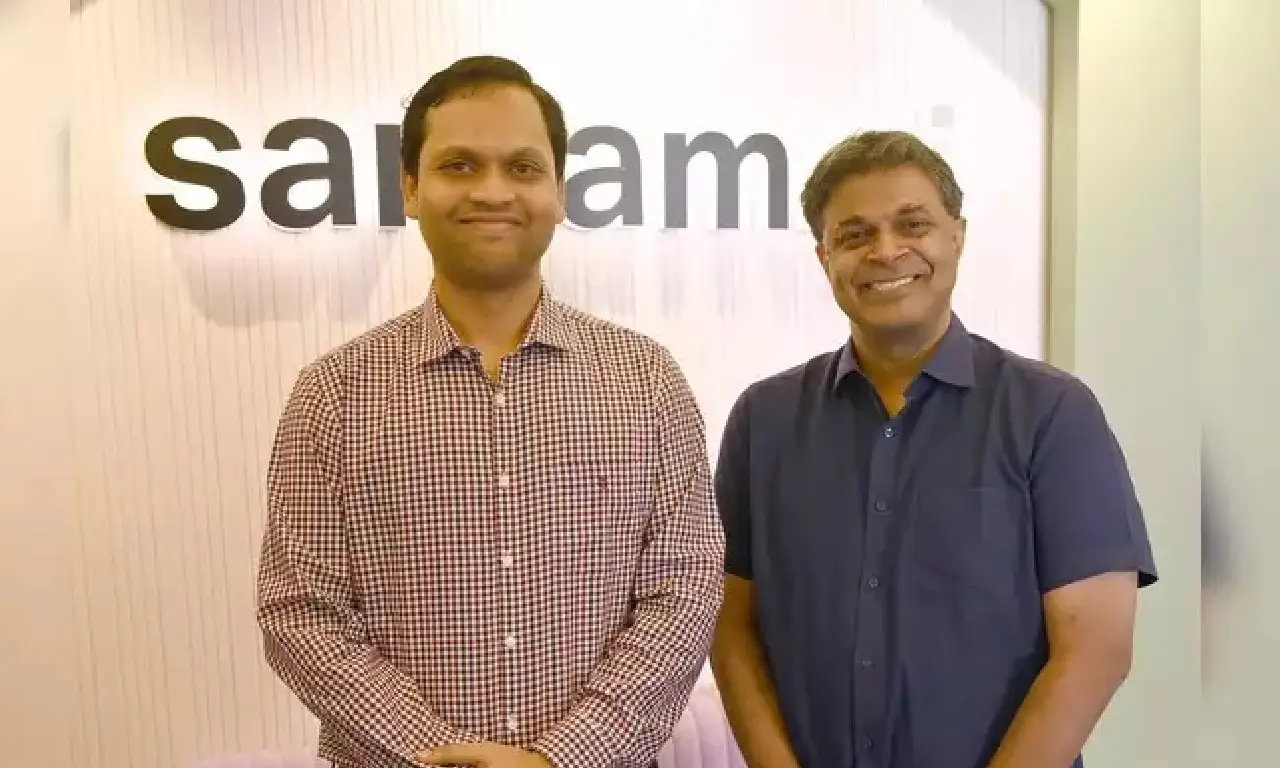
Sarvam AI was founded in 2023 by Vivek Raghavan and Pratyush Kumar, both formerly of AI4Bharat, the IIT Madras-based research group focused on natural language processing for Indian languages. The founding thesis was narrow and specific: general-purpose global LLMs are trained overwhelmingly on English and a handful of high-resource languages, and they underperform on the tokenization, grammar, and code-switching patterns common across India's roughly 22 scheduled languages. India, in this view, needed its own AI infrastructure layer — not a fine-tuned wrapper around an existing foreign model, but models built from the ground up for Indian language structure, sold as API-first infrastructure to enterprises and government, alongside Sarvam's own consumer-facing language products.

That thesis didn't arrive with a shipped product attached. It arrived with a research track record. Before Sarvam existed as a company, Raghavan and Kumar had already built public credibility through AI4Bharat's open research and datasets on Indian-language NLP — work that predated any commercial entity and gave investors something more concrete than a pitch deck to evaluate.
#Research as Credibility
Consumer and SaaS founders typically raise on traction: signups, revenue, retention, some proxy for demand that already exists. Sarvam raised substantially on a different currency — published research quality and an academic pedigree — because in deep tech and AI infrastructure, that currency is a legitimate substitute for commercial traction in a way it isn't almost anywhere else. A model's quality is assessable through benchmarks, papers, and the caliber of the team's prior published work well before there's a product to point to, and investors with domain expertise can underwrite that assessment directly. This doesn't transfer to a consumer app or a vertical SaaS tool, where there is no equivalent research literature to substitute for usage data — the only credible signal of whether people want the product is whether people are already using it. Research credibility works as a fundraising asset specifically in categories where the underlying technology itself can be evaluated on its own technical merits, independent of a market having formed around it yet.
Sarvam didn't raise on what it had built. It raised on what only it could build.
#The Government Tailwind
In April 2025 — roughly sixteen months after its Series A — the Government of India's IndiaAI Mission selected Sarvam, the first company funded from a pool of 67 applicants, to build India's sovereign large language model, with access to government compute infrastructure. That selection functioned as a form of third-party validation that private investors could underwrite alongside their own conviction: a government mission with its own diligence process had independently concluded Sarvam was positioned to lead this category. It reinforced the original thesis after the fact rather than preceding it.
That kind of tailwind is double-edged. It de-risks the raise and the company's positioning in a crowded field — but it also ties a chunk of the company's narrative and roadmap to policy timelines, mission priorities, and political continuity that sit entirely outside founder control. A government mission can be a durable multi-year commitment, or its scope and funding can shift with a change in leadership or budget cycle. Founders who lean heavily on a government-validation narrative are borrowing credibility from an institution whose incentives, while currently aligned, are not contractually bound to stay that way.
From Research to a $1.5B Follow-On
The IndiaAI Mission selection didn't create the thesis. It graded it.
#Why Language Coverage Is the Moat
It's tempting to read '22 Indian languages' as a feature checklist — more languages supported, more market covered. The more accurate read is that language coverage at this scale is a data and engineering moat, not a feature. Building high-quality models across languages with wildly different scripts, morphology, and levels of available training data requires years of India-specific data collection, tokenization work, and evaluation infrastructure that a foreign-first LLM provider has no existing incentive to build, because English and a handful of other high-resource languages already capture the bulk of global demand. A general-purpose model provider optimizing for the broadest possible market will keep deprioritizing India-specific language depth in favor of capabilities that serve larger, higher-revenue markets first.
The 22 Scheduled Languages Sarvam's Models Are Built to Support
This is why narrow geographic and linguistic focus can be a stronger moat than broad general-purpose capability, contrary to the 'bigger model wins' narrative dominating global AI coverage. A larger, more general model isn't automatically better at a specific, narrow, high-friction problem it was never optimized for. Depth on India's 22 languages compounds the same way infrastructure moats compound elsewhere: every dataset collected, every evaluation built, and every enterprise or government deployment shipped makes the next one cheaper and the gap harder for a well-funded generalist to close quickly.
#The Funding Record
Funding Timeline
| Round | Amount | Investor(s) | Context |
|---|---|---|---|
| Series A | $41M | Lightspeed (lead); Peak XV Partners, Khosla Ventures | December 2023 — raised primarily on research credentials and academic pedigree, largely pre-product-scale |
| IndiaAI Mission | Selected (compute support; government body takes equity) | Government of India | April 2025 — first of 67 applicants funded; Mission covers roughly 40% of compute costs, with access to government compute to build India's sovereign LLM |
| Series B | $234M (first close of a $300M round) | HCLTech (lead strategic investor, $150M); Bessemer Venture Partners joining; Peak XV Partners, Khosla Ventures (continued) | June 2026 — $1.5B valuation, four months after Sarvam open-sourced Sarvam-30B and Sarvam-105B at the India AI Impact Summit |
#The Risk of Thesis-Driven, Pre-Revenue Fundraising
Unlike Groww, BrowserStack, or Postman — companies that had demonstrated real user traction well before raising meaningfully — Sarvam raised its first institutional round on a bet about what it could become, not on evidence of what it already was. That's a materially different risk profile for both sides of the table. For founders, a thesis-driven raise means the company has to convert credibility into a real product and real usage on a timeline investors will eventually hold it to, without the cushion of existing revenue to fall back on if execution slips. For investors, it means underwriting a team and a research trajectory rather than a market that has already validated itself, which is a harder and less forgiving bet to get right.
A thesis-driven round doesn't remove the traction requirement. It postpones it.
For a thesis-driven round to pay off rather than stall, several things have to be true simultaneously: the underlying research edge has to be durable rather than easily replicated once well-funded competitors notice the category, the team has to actually ship a product that converts research quality into something enterprises and users will pay for, and — as in Sarvam's case — external validation events like a government mission selection have to materialize roughly on the timeline the fundraising narrative implied. Sarvam's subsequent Series B, priced well above its Series A after real models had shipped and usage had scaled, is what that payoff looks like when the sequence holds. The counterfactual — a thesis that never converts into a shipped product investors can point to — is the same bet failing to clear its own bar, and it's a far more common outcome across deep tech than the highlighted successes suggest.
#What Founders Should Take From This
The practical lesson isn't that pre-product fundraising is broadly available or advisable — for most startups, it isn't. Founders in genuinely novel deep-tech categories, where no comparable shipped product yet exists to benchmark traction against, should treat published research and academic partnerships as a legitimate, investable substitute for traction metrics, and invest in building that credibility early and publicly rather than waiting until they have a product to speak for them. That means publishing real work, not marketing content dressed up as research, and building relationships with institutions whose diligence process investors already trust.
The second, more important lesson is self-assessment: most founders do not have this option, and should not try to force their category into a thesis-driven fundraising narrative it doesn't support. If your category has comparable products already in the market, investors will expect and are right to expect real usage data, not a research thesis, because the traction bar already exists and skipping it reads as a red flag rather than a differentiator. Thesis-driven fundraising is a narrow tool for a narrow category of company — genuinely frontier technical bets where no traction benchmark yet exists — not a shortcut around building a real product.
For founders in deep-tech or genuinely pre-revenue categories trying to work out whether a thesis-driven raise is realistic for their business — or whether they need to hold out and build usage data first — that's exactly the kind of judgment call Fundora Labs' fundraising tools are built to support: benchmarking comparable rounds, modeling how investors are likely to underwrite a pre-traction pitch, and helping you see clearly which side of that line your company is actually on before you're in a room pitching it.
Related Reading
Find your right investors on Fundora
Build a reviewed profile and get AI-matched to investors who fit your stage, sector, and ticket size.