Key Takeaways
- →Skyroot Aerospace launched Vikram-1 into orbit on July 18, 2026, making India the third country in the world with private orbital launch capability — and closed a $60M Series C the same year that made it India's first space unicorn at a $1.1B valuation.
- →Every major funding round in Skyroot's eight-year history followed a demonstrated technical milestone — engine tests, then a suborbital launch, then an orbital launch — not the other way around.
- →Skyroot's model depends structurally on continued access to ISRO infrastructure and IN-SPACe regulatory cooperation, a dependency that founders in similarly policy-gated sectors need to underwrite as a real, ongoing risk rather than a one-time approval.
On July 18, 2026, a privately built Indian rocket reached orbit for the first time. The company that built it, Skyroot Aerospace, became India's first space unicorn in the same year. This is a look at what an eight-year, milestone-gated path to that outcome actually looked like, why the funding moved in lockstep with engineering proof rather than ahead of it, and what founders in similarly capital-intensive, regulation-dependent categories should take from the pace.
#The Founders
Skyroot Aerospace was founded in 2018 in Hyderabad by Pawan Kumar Chandana and Naga Bharath Daka, both former scientists at ISRO, India's national space agency. Their first capital was a $1.5M seed check from Mukesh Bansal — the founder of Myntra and Cure.fit — in June 2018, ahead of any public policy change that would let a private company legally build and fly an orbital rocket in India.


That bet was validated in May 2020, when India's Finance Ministry announced the liberalization of the space sector, opening orbital launch to private companies for the first time. The Indian National Space Promotion and Authorization Centre (IN-SPACe) was subsequently created to coordinate private access to ISRO's infrastructure and regulatory approvals. Skyroot was built, from its earliest days, to be the company that proved this new model could actually work — and it was the first startup to sign an MOU with ISRO for launching its rockets.
The company's business model is to build and operate orbital launch vehicles — the Vikram series, named after Vikram Sarabhai, the founder of India's space program — for small satellite deployment, targeting cost-effective access to space for satellite operators in India and internationally. Its founders' ISRO backgrounds were not incidental to that mission; they were the credibility layer that made the entire model plausible to regulators, infrastructure partners, and early investors alike.
#Funding Tied to Physical Proof
Software startups routinely raise ahead of proof — a compelling team and a credible thesis can justify a round before a product fully exists. Skyroot's history runs in the opposite direction. Its capital raises consistently followed demonstrated technical de-risking, not the other way around: a scaled-down engine test, then a full-duration engine test, then a suborbital launch, then an orbital launch, each one unlocking the next round rather than being funded by it.
Engineering Milestones
Key Technical Milestones
| Date | Milestone |
|---|---|
| December 2020 | Successful test of Kalam-5, a scaled-down solid-fuel engine |
| May 2022 | Full-duration test of Kalam-100, the third-stage engine for Vikram-1 |
| November 18, 2022 | Vikram-S launches from ISRO's Satish Dhawan Space Centre, Sriharikota — India's first privately developed rocket to reach space (suborbital, "Prarambh" mission, ~89.5 km altitude) |
| November 2025 | PM Modi inaugurates Skyroot's Infinity Campus, a 2 lakh sq ft manufacturing facility built for a cadence of one orbital rocket per month, and Vikram-1 is unveiled |
| July 18, 2026 | Vikram-1 launches from Sriharikota and reaches a ~450km orbit roughly 15 minutes after liftoff — the first privately developed Indian rocket to reach orbit, making India the third country globally, after the United States and China, with domestic private orbital launch capability |
Laid against the funding record, the pattern is direct: the December 2020 engine test preceded a 2021 Series A. The 2022 engine test and the November 2022 suborbital launch preceded a January 2022 bridge and a September 2022 Series B. The Infinity Campus inauguration and Vikram-1 unveiling in November 2025 preceded a March 2026 debt raise. And the July 2026 orbital launch landed in the same window as the $60M Series C that made Skyroot a unicorn. Each round arrived once a physical milestone had already reduced the technical risk an investor was being asked to underwrite.
Skyroot's investors weren't underwriting a pitch deck. They were underwriting a rocket that had already left the ground.
This is the defining difference between hard deep-tech fundraising and software fundraising. In software, growth metrics can move continuously and can, to a real degree, be accelerated with more capital — more spend on acquisition, more engineers shipping features, more sales headcount. In aerospace, a full-duration engine test or an orbital launch cannot be compressed by writing a bigger check; physics and manufacturing timelines set a floor on how fast the next milestone can arrive, regardless of how much capital is sitting in the bank. Investors in categories like this calibrate check size and valuation to physical proof points precisely because narrative and projected metrics carry far less information than they do in software — the rocket either reached orbit or it didn't, and no amount of pitch-deck framing changes that.
That reality reshapes the fundraising cadence itself. A software company can often choose to raise on a calendar-driven schedule — every twelve to eighteen months, roughly, timed to growth metrics that compound steadily. A hardware company gated by physical testing and regulatory sign-off cannot choose that cadence; it raises when the next proof point is ready, whether that takes six months or two years. Founders and investors in this category both have to plan around milestone timing, not calendar timing.
#The Public-Private Dependency
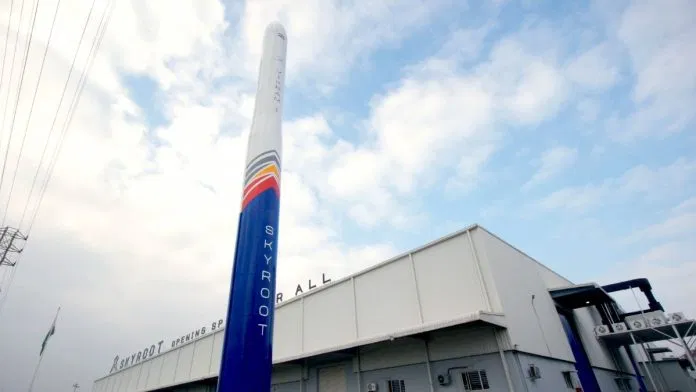
Skyroot did not build its way to orbit alone. ISRO provided motor casting facilities, liquid-engine testing infrastructure, trajectory analysis, safety support, and the launch pad itself. IN-SPACe coordinated the regulatory access and authorization that made flying a privately built rocket from a government spaceport legally possible in the first place. Skyroot built the vehicle — but it launched on a public-private foundation that it does not fully control.
That is a structural dependency, not a one-time hurdle cleared at founding. A venture-backed company whose entire operating model relies on continued access to a specific government agency's physical infrastructure and a specific regulatory body's ongoing cooperation is exposed to a risk category that a purely private-market bet is not: policy risk that sits entirely outside the founders' control. If IN-SPACe's mandate narrows, if ISRO's launch-pad availability becomes constrained by its own mission schedule, or if the space-liberalization policy itself is revisited under a future government, Skyroot's ability to operate is affected in a way no amount of internal execution can fully insulate against.
Skyroot can build the rocket. It cannot build the launch pad, the airspace clearance, or the regulator's continued goodwill.
Founders and investors in similarly policy-dependent sectors — energy, defense, telecom infrastructure — should underwrite this risk differently than they would a purely private-market bet. It is not enough to diligence the technology and the team; the durability of the underlying policy framework, the company's institutional relationships with the relevant regulator, and the realistic downside if that framework shifts all belong in the same underwriting exercise as the product itself. A policy-dependent company's moat and its single largest tail risk are, in practice, the same relationship.
#Why the Valuation Timeline Was Slower — and Why That's Not a Weakness
Skyroot's valuation moved from roughly $550M-equivalent at its October 2023 pre-Series C round to $1.1B at its May 2026 Series C — a rough doubling over approximately 30 months. Set against Fundora's coverage of AI-sector rounds in the same period, that is a notably slower trajectory: Emergent, the AI "vibe coding" platform covered in this series, moved 5x in six months on the back of ARR more than doubling in the same window.
A rocket that reaches orbit on a fixed test schedule cannot be hurried into orbit six months sooner because a term sheet wants it to.
That contrast is not evidence that Skyroot's outcome is weaker. It reflects a fundamentally different kind of underlying asset. Software valuation can re-rate quickly because the metrics behind it — usage, revenue, retention — can genuinely move quickly, sometimes within a single quarter, when a product finds real traction. Skyroot's valuation could not re-rate on the same clock because the milestones behind it were gated by physical testing timelines and regulatory sign-off that no amount of investor enthusiasm could compress. A 30-month path from a $550M-equivalent valuation to $1.1B, resting on a suborbital launch, a manufacturing facility built for monthly launch cadence, and an actual orbital launch, is investors underwriting physics and policy sequentially clearing, not a market pricing in an adoption curve. Judged by what had to be true for the valuation to hold at each step, this is a slower version of the same discipline Emergent's ARR-backed jump reflected — proof preceding price — just running on a much longer physical clock.
#First-Mover Advantage in a Regulation-Gated Market
Skyroot was the first startup to sign an MOU with ISRO for launching its rockets. That fact matters beyond its symbolic value. In a newly liberalized or newly regulated market, being the first credible private entrant to establish trusted, working terms with the relevant government body creates a form of moat that has little to do with the underlying technology and everything to do with institutional trust built under conditions no later entrant can fully replicate.
The founders' ISRO backgrounds compounded this advantage rather than merely supporting it. Chandana and Daka were not outside parties negotiating access to a government agency they had never worked inside; they understood ISRO's technical standards, safety culture, and institutional process from direct prior experience, which shortened the trust-building cycle that a founding team without that background would have had to run from zero. A competitor with comparable or even superior propulsion technology, entering the market after Skyroot had already established working relationships with ISRO and IN-SPACe, would still face a slower path to the same level of institutional cooperation — regulatory relationships, unlike code, cannot be reverse-engineered from a public specification.
This is a distinct category of moat from the ones most venture-backed companies compete on. It doesn't show up in a product demo, and it doesn't compound the way a network effect or a data advantage does. But in any market where a government body is the sole gatekeeper to essential infrastructure, being first to establish credible, trusted terms with that gatekeeper is durable in a way that is difficult for a well-funded later entrant to buy their way around quickly.
#The Funding Record
Skyroot's Funding Timeline
| Stage | Amount | Key Investors | Timing / Context |
|---|---|---|---|
| Seed | $1.5M | Mukesh Bansal (individual) | June 2018 |
| Series A | Undisclosed | Multiple institutional and angel investors | 2021 |
| Bridge | $4.5M | Sherpalo Ventures (Ram Shriram) | January 2022 |
| Series B | Undisclosed | Multiple investors, including Sherpalo Ventures | September 2022 |
| Pre-Series C | $27.5M | Led by GIC (Singapore's sovereign wealth fund); brought total raised to ~$95M at the time | October 2023 |
| Debt financing | ₹100 crore (~$10.75M) | BlackRock, via non-convertible debentures — Skyroot's first debt raise | March 2026 |
| Series C | $60M | Co-led by GIC and Sherpalo Ventures; also including founders of Greenko Group, Arkam Ventures, funds managed by BlackRock, Playbook Partners, and the Shanghvi Family Office | May 7, 2026 — valued Skyroot at $1.1B, India's first space unicorn |
Series A and Series B amounts were not disclosed in available sources and are marked as such rather than estimated. Skyroot is an active, recently-funded company operating in a nationally significant story; confirm these figures and the July 2026 orbital launch details against current reporting before treating them as final.
#What Founders Should Take From This
Founders building in capital-intensive, regulation-dependent, or physically-proof-gated categories should expect and plan for a fundraising cadence tied to milestone completion rather than calendar time — and should say so explicitly to investors rather than trying to force a software-style raise timeline onto a hardware or regulatory reality. A pitch that promises a Series B in twelve months when the next real de-risking event is eighteen months away sets an expectation the company cannot meet on physical grounds, regardless of execution quality.
Founders entering newly liberalized or newly regulated sectors should weigh the specific advantage of being first to establish institutional trust and working relationships with the relevant regulator or public body. That relationship can be as defensible as any proprietary technology, precisely because it cannot be copied from a spec sheet — it has to be built, under real conditions, over time, the way Skyroot built its standing with ISRO and IN-SPACe well before any competitor could.
And founders in this category should read valuation timelines differently than the software playbook suggests. A slower, proof-gated path to a large outcome is not evidence of a weaker company — it can be evidence of a company whose milestones were real enough that investors were willing to underwrite them one at a time, on the timeline physics and policy actually allowed, rather than a timeline a term sheet wanted.
For founders building in categories where the next raise depends on a physical test, a regulatory approval, or a government partnership clearing rather than a growth metric moving — and who are trying to work out what a realistic fundraising cadence actually looks like for a company like theirs — that's the kind of milestone-based planning question Fundora Labs' fundraising tools are built to help think through, rather than defaulting to a software-sector timeline that doesn't fit the underlying business.
Related Reading
Find your right investors on Fundora
Build a reviewed profile and get AI-matched to investors who fit your stage, sector, and ticket size.